product
Optimizing Sublimation Efficiency: Thermal Dynamics in Pineapple Dehydration
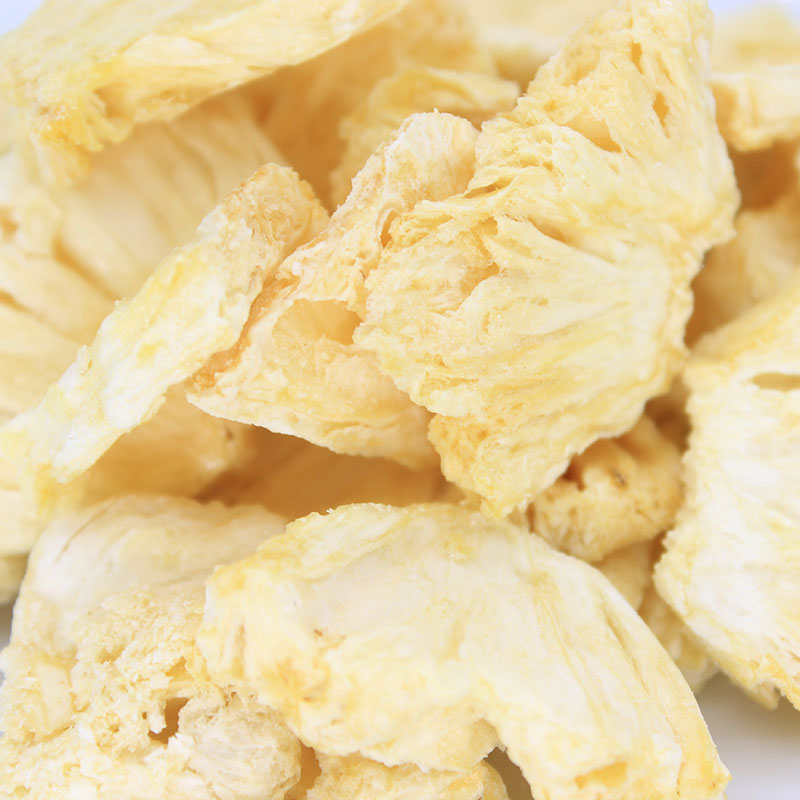
In an industrial food processing environment, time is money. Determining the "Drying Curve" for pineapple involves balancing the triple point of water with the thermal conductivity of the fruit's fibrous structure. For commercial-scale freeze-drying, the goal is to reach a moisture content of <3% in the shortest possible window, typically achieved in 16 to 22 hours through advanced cycle programming.
The Physics of the "Sugar Trap"
Pineapple contains significant amounts of fructose and glucose. During the freeze-drying process, these sugars can create a "glazing" effect on the surface of the fruit. This glaze acts as a vapor barrier, increasing resistance to mass transfer. To counteract this, industrial machines use Ramped Shelf Temperatures to provide just enough energy for sublimation without melting the ice (which would cause "collapse" or "puffing").
Cycle Parameter Analysis
Industrial cycles are broken down into precise segments. The following table illustrates how vacuum levels and shelf temperatures interact with the time required to remove water:
| Process Phase | Vacuum Level (mTorr) | Shelf Temp (°C) | % of Total Time |
| Flash Freezing | Ambient | $-40^{\circ}\text{C}$ | 15% |
| Primary Drying | 100 - 200 | $+15^{\circ}\text{C}$ | 60% |
| Secondary Drying | 50 - 80 | $+45^{\circ}\text{C}$ | 20% |
| Final Equilibrium | 50 | $+20^{\circ}\text{C}$ | 5% |
Factors Influencing Industrial Output
-
Vapor Pressure Differentials: By maintaining a significant pressure difference between the product surface and the ice condenser, processors can force moisture out of the dense pineapple fibers more rapidly.
-
Solids Content: The "Brix" level (sugar concentration) of the pineapple is measured before loading. High-Brix pineapple (very ripe) requires a longer secondary drying phase to remove "bound water" that is chemically attached to the sugar molecules.
-
Surface Area-to-Volume Ratio: Industrial processors often utilize uniform "dicing" to maximize the surface area, ensuring that heat can penetrate to the center of each piece quickly, thereby reducing the total residency time in the vacuum chamber.