Product News
Strategic Nutrition: The Industrial and Ecological Role of Freeze-Dried Fruit Powder
Strategic Nutrition: The Industrial and Ecological Role of Freeze-Dried Fruit Powder
In the global effort to build a more resilient and sustainable food system, the focus has shifted from "fresh at all costs" to "optimized stability." At the heart of this transformation is freeze-dried fruit powder. While the casual observer might see it as a mere flavoring, industry professionals recognize it as a high-tech solution for carbon reduction, waste mitigation, and the delivery of bioavailable micronutrients in environments where fresh produce is a liability.
What do we use freeze-dried fruit powder for in a professional and industrial context? We use it to solve the Water-Waste-Weight trilemma of the 21st-century food supply chain.
1. The Logistics of "Empty Weight": Carbon Footprint and Sustainability
One of the most significant, yet overlooked, uses of freeze-dried fruit powder is the optimization of global logistics. Fresh fruit is composed of approximately 80% to 90% water. From a transport perspective, shipping fresh fruit means shipping "heavy water" that requires refrigerated "cold chains," which are energy-intensive and prone to high spoilage rates.
The Efficiency Dividend
By converting whole fruit into a shelf-stable powder at the point of harvest, we eliminate the need for refrigerated shipping.
-
Weight Reduction: One metric ton of fresh strawberries is reduced to roughly 100kg of freeze-dried powder.
-
Volume Compression: Powder can be densely packed, requiring fewer containers and significantly lowering the carbon footprint per nutrient unit.
-
Waste Mitigation: Approximately 30% of fresh produce is lost in the "last mile" of the supply chain. Freeze-dried powder has a near-zero spoilage rate over a 24-month period.
Table 1: Ecological and Logistics Comparison
| Logistics Metric | Fresh Fruit (Global Shipping) | Freeze-Dried Fruit Powder | The "Powder" Advantage |
| Water Content | 85% - 92% | 1% - 3% | 90% lighter payload |
| Storage Temperature | 2℃-4℃(Strict) | Ambient (Cool/Dry) | 70% reduction in energy use |
| Shelf Life | 7–14 Days | 12–24 Months | Massive reduction in landfill waste |
| Packaging Efficiency | High (Bulk/Protective) | Very High (Vacuum/Space-saving) | More nutrients per cubic meter |
2. Food Engineering: Managing Water Activity (aw)
In industrial food formulation, the "enemy" of shelf life is Water Activity (aw). Most pathogens and molds require a certain level of available water to proliferate. This is where freeze-dried fruit powder serves as a functional "dry solid."
Stabilizing Complex Matrices
When manufacturers create products like protein bars, chocolate inclusions, or dry cereal blends, they cannot use fresh fruit because the moisture would migrate into the surrounding ingredients (e.g., making the chocolate bloom or the cereal soggy).
-
Moisture Sequestration: Freeze-dried powder allows for the introduction of high fruit concentrations without raising the $a_w$ of the final product.
-
Textural Integrity: It provides a "clean snap" in bars and chocolates while delivering a burst of authentic fruit flavor that rehydrates upon contact with saliva.
3. The "Nutritional Pause Button": Bioavailability vs. Freshness
There is a common misconception that "fresh" fruit in a grocery store is the gold standard for nutrition. However, fruits start losing vitamins (particularly Vitamin C and Thiamine) the moment they are picked. A "fresh" blueberry that has traveled for 10 days often has a lower nutrient density than a berry that was flash-frozen and powdered within hours of harvest.
Retaining Phytonutrients
Freeze-drying is a non-thermal dehydration process. Because it bypasses the high temperatures of sun-drying or tunnel-drying, the delicate molecular structures of antioxidants (anthocyanins, polyphenols) are preserved.
-
Bioavailability: The powder form actually increases the surface area of the fruit, potentially making it easier for the digestive system to access and absorb micronutrients.
-
Functional Supplements: This is why freeze-dried powders are the primary choice for encapsulated supplements and superfood blends. You aren't just getting flavor; you are getting a biologically active "whole food" matrix.
4. The "Clean Label" Pivot: Consumer Trust and Transparency
Modern consumers are scanning labels for "E-numbers" and synthetic additives. Freeze-dried fruit powder is the primary engine behind the Clean Label Movement.
Replacing the Synthetics
Food scientists use fruit powders to replace three major categories of additives:
-
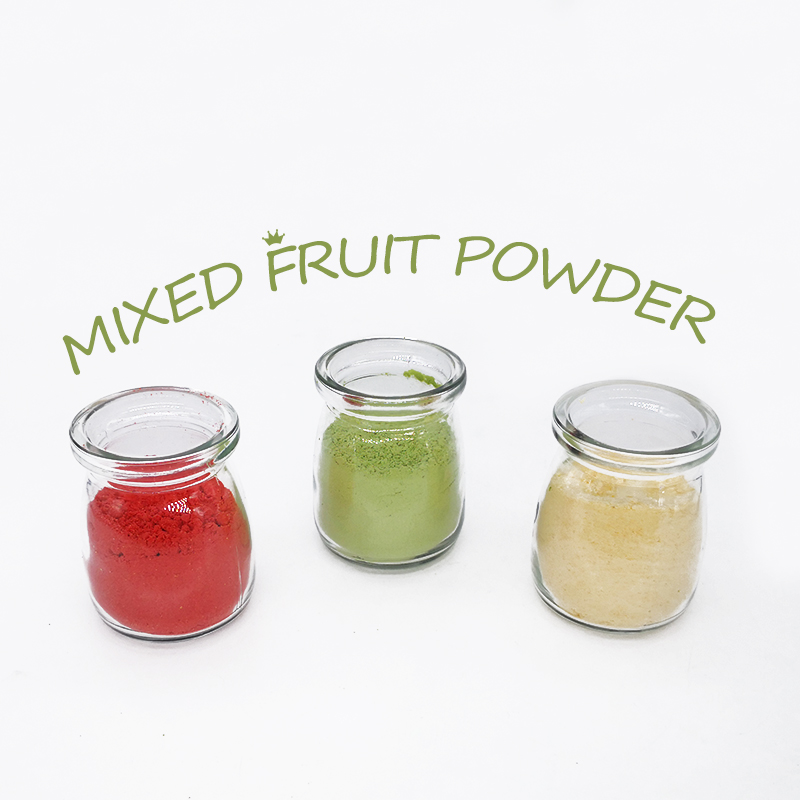
Synthetic Dyes: Using beetroot or pitaya powder instead of red 40.
-
Artificial Flavors: Using concentrated pineapple or passion fruit powder instead of "natural and artificial flavors."
-
Chemical Preservatives: The low moisture content of the powder acts as a natural preservative, allowing brands to market products with "No Preservatives Added."
Table 2: Clean Label Ingredient Replacement Guide
| Target Function | Synthetic/Standard Ingredient | Freeze-Dried Powder Alternative | Consumer Benefit |
| Coloring (Red) | Red Dye #40 | Raspberry or Dragon Fruit | Allergen-free, plant-based |
| Coloring (Yellow) | Tartrazine (Yellow 5) | Mango or Sea Buckthorn | Non-toxic, nutrient-dense |
| Flavoring | Ethyl Methylphenylglycidate | Strawberry Powder | Authentic aroma, "Real Fruit" on label |
| Thickening | Modified Corn Starch | Banana or Apple Powder | Fiber-rich, gluten-free |
5. Specialized Industrial Applications
Outside of the typical bakery or kitchen, freeze-dried fruit powder is used in highly specialized sectors that demand performance under pressure.
Infant Nutrition (The "First Foods" Industry)
The baby food industry uses freeze-dried powders for "puffs" and "melts."
-
Safety: The powder dissolves instantly, eliminating the choking hazards associated with fresh fruit skins or chunks.
-
Flavor Training: It helps infants develop a palate for the actual taste of fruit, rather than the overly sweet, heat-processed taste of traditional jarred purees.
The Aerospace and Defense Sector
Space exploration and military "MREs" (Meals Ready-to-Eat) rely on freeze-dried technology.
-
Psychological Well-being: In extreme environments, the sensory experience of "real fruit" flavor provided by powders is a significant morale booster.
-
Weight Ratios: For every kilogram of weight saved on a spacecraft or a soldier's pack, thousands of dollars in fuel or energy are conserved.
Pharmaceuticals and Nutricosmetics
The "Beauty from Within" trend uses freeze-dried powders (like Acerola Cherry) in ingestible powders and gummies. These fruits are chosen for their high concentration of natural Vitamin C, which is a precursor to collagen production.
6. Operational Challenges: The "Sugar-Glass" State
Professional users must understand the glass transition temperature of fruit powders. Because fruits are high in fructose, the powder can shift from a free-flowing state to a "rubberized" or "glassy" state if exposed to heat and humidity.
Industrial Mitigation:
-
Anti-caking Carriers: Some commercial powders include a small percentage of organic maltodextrin or rice hull to act as a "spacer" between the sticky fruit particles.
-
Cold-Milling: High-end powders are milled in temperature-controlled environments to prevent the friction heat from melting the natural sugars.
7. Summary: Industry Vertical Use-Cases
| Vertical | Operational Goal | Strategic Use of Powder |
| Dairy/Plant-Based | Flavoring Yogurt/Ice Cream | Prevents "ice crystals" caused by water in fresh fruit. |
| Health/Wellness | High-Protein Bars | Adds fiber and antioxidants without making the bar "mushy." |
| Cosmetics | Natural Face Masks | Delivers active Vitamin C without synthetic stabilizers. |
| Distilling | Fruit-infused Spirits | Extracts flavor and color without diluting the alcohol proof. |
Conclusion: The Future of Efficient Nutrition
What do we use freeze-dried fruit powder for? We use it to bridge the gap between nature's seasonal bounty and the 24/7 demands of a global population. It is an ingredient that respects the biological complexity of the fruit while adhering to the rigorous physical requirements of modern food engineering.
As we move toward a more sustainable future, freeze-dried fruit powder will no longer be seen as an "alternative" ingredient—it will be the standard for any brand that values nutritional integrity, clean labels, and environmental responsibility. It is the most technologically advanced way to ensure that the "flavor of the orchard" can be enjoyed anywhere on Earth (or off it), with zero waste and maximum impact.